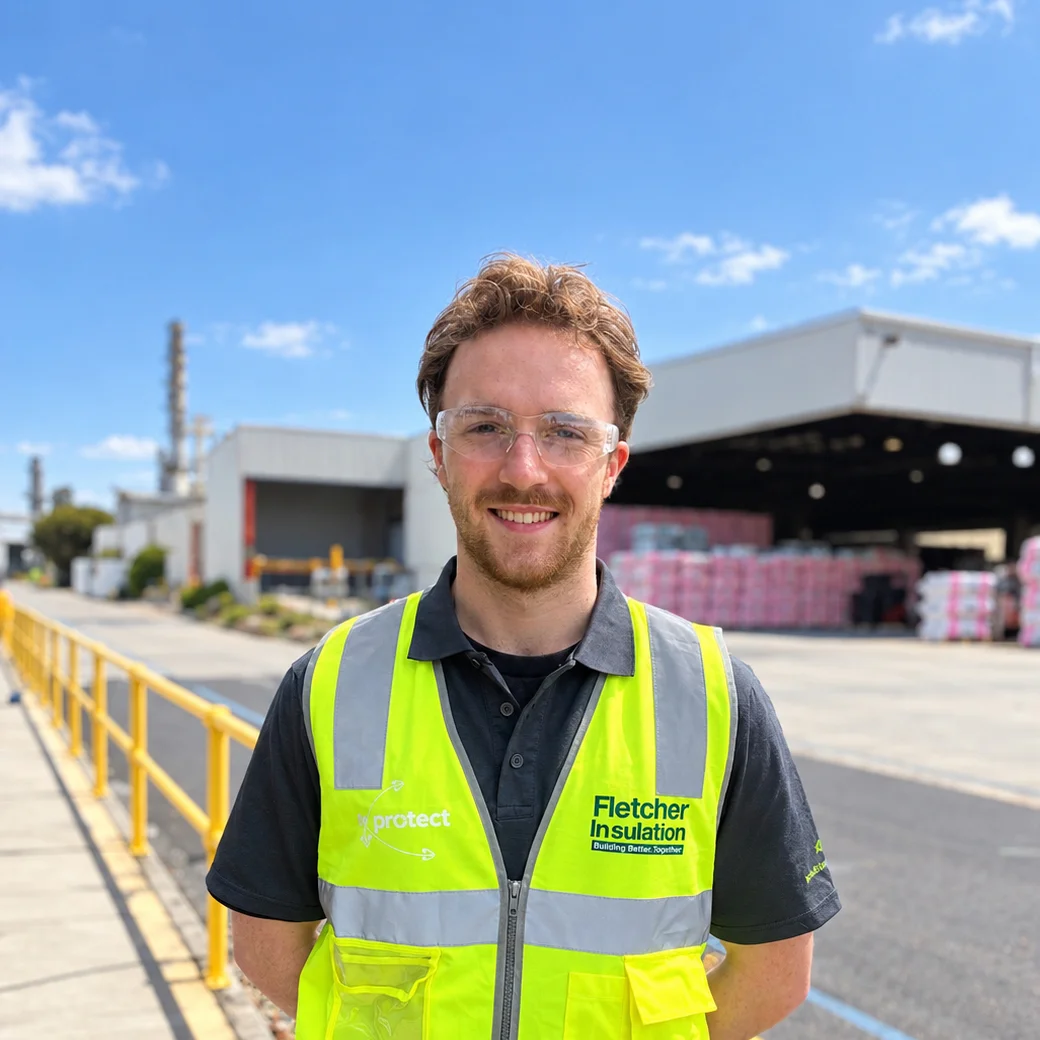
For Fletcher Insulation Engineering Trainee Jack Littleford, no two days are quite the same. From tackling engineering challenges to working alongside experienced operators and maintenance teams, it’s the variety of manufacturing that keeps him interested and constantly learning.
Jack joined Fletcher Insulation in 2024 through an industry placement as part of his mechanical engineering degree at Swinburne University of Technology. What initially attracted him was the opportunity to get involved in real projects, take on responsibility and see the results of his work firsthand.
Since then, he’s gained experience across mechanical engineering, automation, safety and process improvement, discovering just how much there is to learn beyond the university classroom.
A bit of a jack of all trades
For Jack, the appeal of mechanical engineering has always been its versatility.
“Mechanical engineering is really broad. You can work in almost any industry, from traditional manufacturing all the way through to designing space shuttles,” he explains.
“Mechanical is a little bit like a jack of all trades, where you touch on many areas and aren’t really forced to stay in one lane. I really value that and enjoy the challenge.”
That curiosity and willingness to try different things have served him well at Fletcher Insulation.
When Jack first interviewed for his placement, it was the range of projects on offer that caught his attention, along with the opportunity to make a meaningful contribution.
“I think the main thing that got me excited was the opportunity to run projects. It’s something that can be difficult but really rewarding, and I’m slowly learning and improving at it.”
He didn’t have to wait long to get started. From early on, Jack was given responsibility for his work and encouraged to become involved in projects across the manufacturing operation.
Learning beyond the classroom
Ask Jack about the biggest difference between studying engineering and working in manufacturing, and he’s quick to point out how much more there is to learn once you’re on the job.
At university, the focus is on understanding engineering principles and building a foundation of knowledge. In a manufacturing environment, those principles become part of everyday decisions, often with immediate and visible results.
“There’s so much more gravity to the decisions and the work you do. It really means something, and you can immediately see the outcome of decisions you make ,” he says.
For Jack, that practical experience has been invaluable.
Over his time at Fletcher Insulation, he’s worked on a wide range of engineering projects, from equipment and process improvements through to automation and safety initiatives.
He’s also had opportunities to contribute to projects at Sonata Acoustic Panels and Baron Insulation, broadening his experience across different manufacturing operations.
“Being at a manufacturing business really gives you exposure to so many interesting problems to solve and projects to work on.”
It’s the variety that Jack particularly enjoys. One project might call for mechanical design skills, while another involves working with electrical specialists, understanding operational requirements or coordinating with different teams and stakeholders.
Finding solutions that make a difference
One of Jack’s most rewarding experiences has been contributing to projects that improve manufacturing operations and workplace safety.
In one project, he was involved in developing and implementing additional engineering controls to enhance equipment safety.
This work involved collaborating with operators, maintenance personnel and other stakeholders to understand operational requirements, develop a practical solution and assess its effectiveness.
For Jack, it was an opportunity to put his engineering knowledge into practice while learning best practices from the experience of others.
Projects like these have also helped him appreciate that engineering is about much more than calculations and technical design. Communication, collaboration and understanding how various systems interact are just as important.
The people make the difference
While Jack has enjoyed the technical challenges, one of the things that has stood out most is the people he’s met along the way.
“What surprised me was how welcoming everyone was from day one. People will give you a smile or a wave when you walk past,” he says.
He’s particularly appreciative of the willingness of experienced colleagues to share their knowledge.
“Operators and maintenance people are always willing to help if they have some time to spare. Even within the engineering team, people will set aside hours of their time just to bring me up to speed on different topics and best practices.”
That support, combined with the freedom to take responsibility for projects, has played a big part in his development.
Jack believes the trust Fletcher Insulation places in people early in their careers is something worth recognising.
“I think the willingness of a business to train, trust, and invest time in young or inexperienced people is very rare, but Fletcher Insulation is really good at this.”
A new appreciation for Australian manufacturing
Working at Fletcher Insulation has also changed Jack’s perspective on Australian manufacturing.
Before joining the business, he hadn’t fully appreciated the scale of local manufacturing operations or the range of skills and expertise involved.
“I didn’t realise before working in this industry just how rare it is to manufacture in Australia, especially on a large scale as we do.”
He’s also developed an appreciation for the care that goes into producing insulation and the pride people take in their work.
“We’re not satisfied with ‘good enough’, and people take a lot of pride in making an excellent product that leads the market.”
For Jack, seeing that commitment firsthand has reinforced the importance of supporting Australian manufacturing and the vast opportunities it creates for people in engineering and related fields.
Saying yes to new challenges
If there’s one lesson Jack would pass on from his experience so far, it’s to keep an open mind and be prepared to step outside your comfort zone.
“The most valuable lesson I’ve learnt is to keep saying yes to opportunities that stretch your comfort zone. I’ve found you can provide a lot of value and growth by being open minded and willing to learn new things.” he says.
“If I was only interested in purely mechanical engineering and didn’t give any thought to other fields like electrical, process improvement, operations or procurement, I’d be much less knowledgeable and much less likely to get fulfilment out of my work. ”
It’s advice he’d also give to engineering students considering a career in manufacturing.
With so many different disciplines coming together, he believes it’s an ideal environment to learn quickly, build relationships and discover where your interests might take you.
“The networking opportunities, variety of work, exposure to technology and rapid learning are so important as a young person entering the field.”
And for Jack, it’s clear that he’s found an environment where he can continue to challenge himself.
“I take a lot of pride in the work I do, and I think being busy doing something I enjoy is what makes me excited to get up and go to work.”
Fletcher Insulation’s Australian-made glasswool products include Pink Batts®, Soundbreak®, FirmaSoft® and Pink® Partition. Learn more about our Australian manufacturing and our brands.