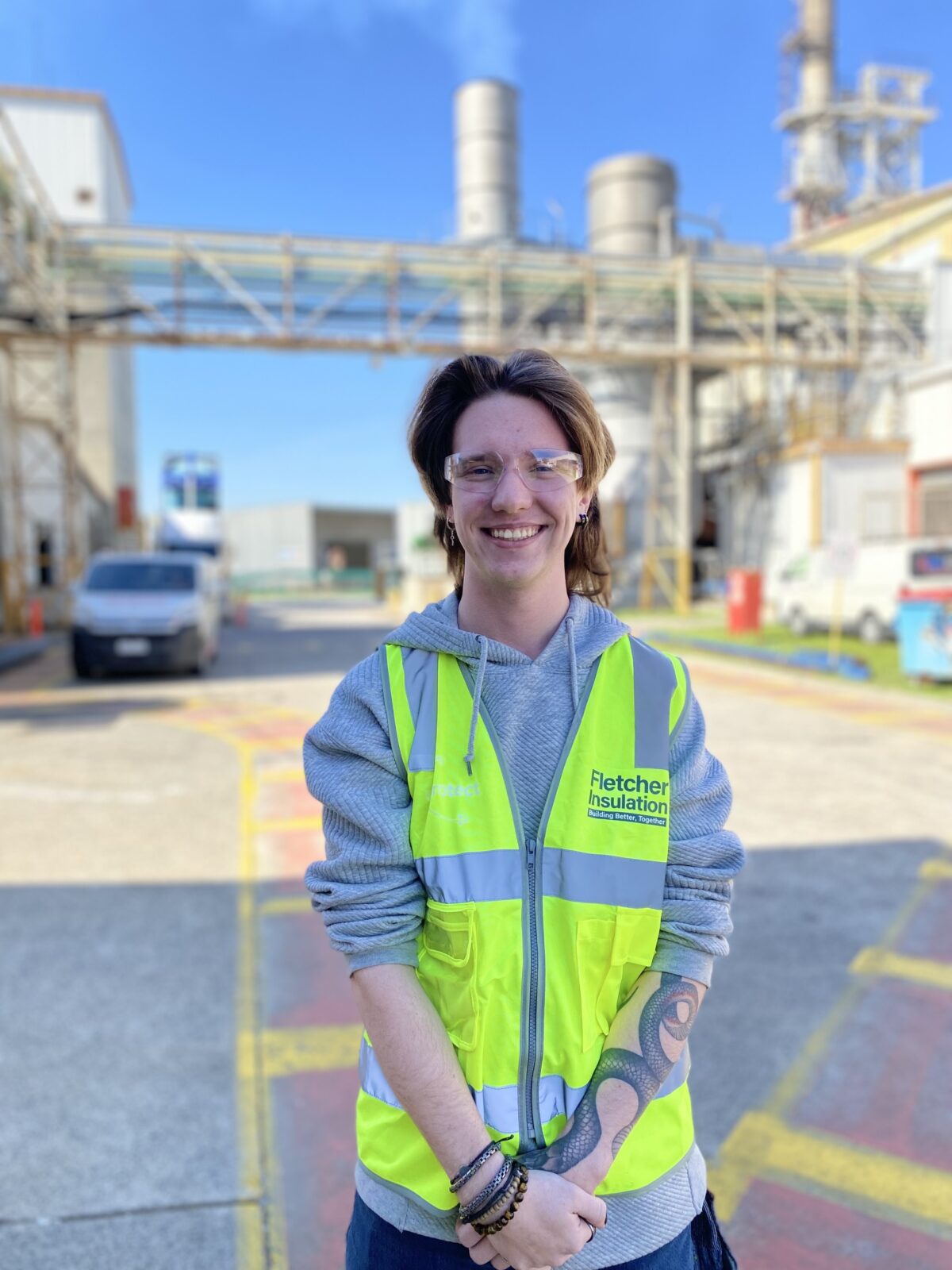
Engineering pathways don’t always start in a lecture theatre. For Caleb Trotman, a Mechatronics and Robotics Engineering intern at Fletcher Insulation, the journey began much earlier – with a mix of creativity, curiosity and a desire to understand how things work.
“I was a kid who loved to make art and create things but also happened to be quite adept at maths,” Caleb explains. “Engineering brings those two things together – understanding the numeric side of the world but also thinking creatively.”
That early interest took shape in high school through robotics, where Caleb built his first autonomous system. Today, he’s applying that same mindset in a very different environment – a live manufacturing plant, working with complex control systems that support insulation production at scale.
What is mechatronics — and why it matters
At its core, mechatronics is about integration.
“Mechatronics is the combination of mechanical, electrical and software engineering to create automated and intelligent systems,” Caleb says. “It’s about using sensors, PLCs and control logic to monitor and control processes with efficiency and precision.”
While often associated with robotics or emerging technologies, Caleb points out that manufacturing is where these systems come together in a very real, practical way. It’s an environment where theory meets reality – and where performance, safety and reliability all matter.
Automation on the factory floor
At Fletcher Insulation, automation plays a critical role in ensuring consistent product quality, operational efficiency and safety.
“Automated systems control things like material handling, temperature and line processes, and everything can be monitored through a Human Machine Interface,” Caleb explains.
During his internship, Caleb has worked with a range of systems, including Distributed Control Systems (DCS), Programmable Logic Controllers (PLCs), and site Human Machine Interfaces (HMIs) – contributing to continuous improvement projects and developing new control functions.
These systems are not isolated. They operate as part of a connected production environment where even small adjustments can have wide-reaching effects.
“What surprised me most was how the smallest control change can impact the entire production line,” he says. “It really reinforces the need for careful planning, testing and communication.”
Seeing integration in action
One of the defining features of mechatronics is the integration of multiple engineering disciplines – something Caleb has seen firsthand across the production line.
“From the batch house through to end-of-line bagging, you can see mechanical, electrical and software systems working together,” he says.
In areas like the forming process, this integration becomes even more complex. Sensors, cameras, valves and flowmeters continuously monitor conditions such as temperature and glass pull rate, feeding data back into control systems that maintain stable operation and flag potential issues.
“It’s a system that’s constantly checking itself — and responding in real time.”
Improving systems, improving outcomes
A key part of Caleb’s internship has been contributing to process improvement.
One standout project involved recommissioning a cooling system designed to manage product temperature before it enters the oven.
“This system cools the product to prevent the resin binder from curing too early,” Caleb explains. “That helps improve both emissions and product quality.”
It’s a practical example of how engineering decisions at a systems level can influence outcomes across the entire production process – from environmental performance through to final product consistency.
Learning beyond the textbook
Like many engineering students entering industry, Caleb quickly discovered that real-world systems are far more complex than their theoretical counterparts.
“In university, systems are often simplified,” he says. “In reality, you’re dealing with equipment limitations, safety requirements and operational constraints. Learning how to troubleshoot in that environment has been incredibly valuable.”
Equally important has been collaboration.
“To really understand how a system works, you need to work closely with operators and maintenance teams. Their experience is critical to building something that works in practice.”
The Future of manufacturing
Looking ahead, Caleb sees automation as central to the future of Australian manufacturing.
“As the industry continues to adopt advanced automation, we’ll see improvements in efficiency, cost and product quality,” he says. “It also allows manufacturers to be more adaptable in a changing global market.”
For Fletcher Insulation, that capability supports the ongoing manufacture of high-performing insulation solutions for Australian buildings — including Australian-made glasswool brands such as Pink Batts®, Soundbreak® and Pink® Partition — where consistency, quality and performance are critical.
Building a career in systems
The experience has also helped shape Caleb’s career direction.
“This internship has shown me that I really enjoy working with complex systems in manufacturing,” he says. “There’s a lot of knowledge here, and a lot of opportunity to keep learning and developing.”
It’s a reminder that behind every manufactured product is a network of systems – and people – working together to deliver performance.
And for emerging engineers like Caleb, that’s where theory becomes something much more tangible: real-world impact, built system by system.